The Statue by Stevens Ben
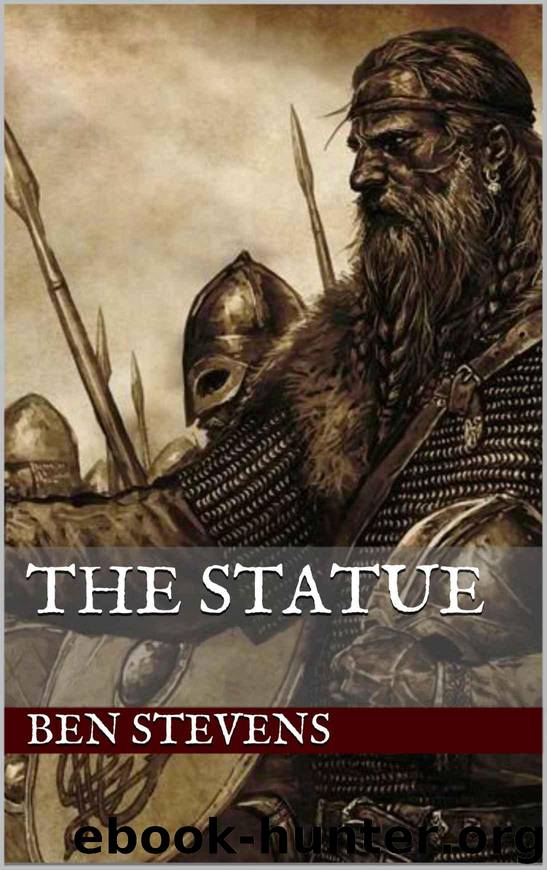
Author:Stevens, Ben [Stevens, Ben]
Language: eng
Format: azw3
Publisher: Nanbanjin
Published: 2013-06-09T04:00:00+00:00
Most of Hawarden gathered for Monday’s trial. The shire-reeve sat at a table in the field, beside him a scribe who would record everything that was said and done. For while Selwyn could read and write himself, he could not be expected to administer justice as well as keep a record of all that took place.
Most of the cases the shire-reeve heard were between neighbours, petty disputes over land, animals or something of the sort that could quickly be settled by means of a small fine – were such a thing deemed warranted.
Other, more serious cases such as wegreaf – highway robbery – could (if the defendant was adamant that he was innocent of all charges brought) be judged by trial of ordeal, where the man might with his hand have to retrieve a stone from a kettle filled with boiling water, or carry a red-hot iron bar a certain number of feet.
In either case, the injured hand was bandaged and then examined three days later. If it was obviously healing, then the defendant was deemed innocent and the charge (or charges) dropped. But if the hand remained festering or infected, clearly not healing, then the defendant had been abandoned by God and was thus judged guilty.
Today, it fell upon Daegberht to open the proceedings, given that it was he who had brought the case before the court.
‘By the Lord,’ said the blacksmith, stood before the table where the shire-reeve and the scribe were sat, ‘let it be known that I accuse this statue’ – here he pointed at the wooden effigy that had been brought from the church – ‘with malicious and deliberate forethought, of having caused the death of my wife.’
A murmur passed through the assembled villagers, before the shire-reeve quietened them with a sign. For it had been noted that Daegberht had claimed premeditation; those charged only with leod or manslaughter could, with extenuating circumstances or just good fortune, escape a death sentence with the maiming of a limb, or even just a fine.
Now that the accusation had been given, those gathered awaited to see if a miracle would take place. Would the statue of the Virgin Mary give an athi – the customary oath sworn by the defendant who pleaded not guilty?
By the Lord, I am guiltless both of deed and instigation of the crime with which … charges me.
This, when accompanied by an oath-helper’s declaration – By the Lord, the oath is pure and not false that … swore – was usually sufficient for the defendant to be judged not guilty.
Hawarden was, like most villages, reasonably small, and through a complicated web of relations, oaths and promises its residents were usually aware of their neighbours’ most intimate business.
Thus was it difficult (indeed almost impossible) for a truly guilty person to find someone who was prepared to act as an oath-helper, especially for those – like the statue of the Virgin Mary – who’d been caught red-handed in the act of which they were accused.
The statue said nothing to defend itself.
Download
This site does not store any files on its server. We only index and link to content provided by other sites. Please contact the content providers to delete copyright contents if any and email us, we'll remove relevant links or contents immediately.
Spell It Out by David Crystal(36149)
Underground: A Human History of the Worlds Beneath Our Feet by Will Hunt(12144)
A Year in the Merde by Stephen Clarke(5470)
Venice by Jan Morris(2611)
Claridge's: The Cookbook by Nail Martyn & Erickson Meredith(2437)
My Paris Kitchen: Recipes and Stories by Lebovitz David(2319)
A TIME OF GIFTS by Patrick Leigh Fermor(2226)
The Plantagenets by Dan Jones(2117)
Welcome to the Goddamn Ice Cube by Blair Braverman(2070)
The Finnish Way by Katja Pantzar(2028)
From Russia with Lunch by David Smiedt(2021)
Top 10 Prague (EYEWITNESS TOP 10 TRAVEL GUIDES) by DK(2017)
Bang Poland: How To Make Love With Polish Girls In Poland by Roosh V(2002)
The Isle of Mull by Terry Marsh(1984)
A TIME TO KEEP SILENCE by Patrick Leigh Fermor(1934)
Rick Steves London 2018 by Rick Steves & Gene Openshaw(1897)
Insight Guides Experience Tokyo by Insight Guides(1883)
A Taste of Paris by David Downie(1881)
Merde in Europe by Stephen Clarke(1799)
